
In North America, United Airlines has the largest fleet of Boeing 777 300 ER Economy. Not all seats on an airplane are created equal. Some make the trip more comfortable, and others can make it challenging, particularly on a long-haul flight. Let’s say you booked a flight with United Airlines. Now comes the main decision—which seat to choose? Because this will make all the difference to your trip.
Here's the breakdown of the United Airlines 777-300ER economy cabin for an active seat map seeker who is looking to make the right choice. Get all the information you might need to match the seat to your travel and body style.
The Aircraft at a Glance
The Boeing 777-300ER is operated mainly on the transpacific routes by United (Los Angeles to Tokyo, San Francisco to Sydney, New York/Newark to Frankfurt, etc.). If you're traveling on a 10-hour or longer United flight across the ocean, odds are that you're on this plane.
The economy cabin is configured in a 3-4-3 layout across ten rows of three sections. Ten seats per row on a plane that was originally designed for nine, something major airlines have embraced in the 2010s to squeeze more money out of the seats and a practice that has come under constant criticism from passengers. The outcome is a 17.3-inch seat width that's definitely narrow, especially for long-haul flights.
The 3-4-3 configuration will allow four passengers to be seated in the middle seat of the center block. In fact, it's convenient if you're traveling in a group of four. This aisle seat next to that center block is a great choice when traveling alone.
United Economy Cabin Specifications
The United Airlines 777-300ER economy promises passengers decent amenities. The Boeing cabin is designed for a relaxed journey, especially for short-haul flights. However, long-haul flights above 14 hours can be tiring and exhausting. Go through the table below and understand what you are getting with United Economy Cabin booking.
| Feature | Specification | Verdict |
| Seat configuration | 3-4-3 across 10 seats per row | Cramped |
| Seat width | 17.3 inches | Below average |
| Seat pitch (standard) | 31 inches | Average |
| Seat pitch (Economy Plus) | 34–36 inches | Good |
| In-seat power | AC outlet + USB-A at every seat | Excellent |
| Entertainment screen | 13-inch personal screen (AVOD) | Very good |
| Recline | 3 inches standard | Average |
| Wi-Fi | Available (satellite, fee applies) | Variable |
| Meals (int'l routes) | Complimentary meal service | Included |
Best Economy Seats on the United 777-300ER
Careful research is rewarded with the selection of the best United Boeing 777-300ER economy seats. The odds of making it to the destination in good shape versus coming in looking like a wreck can be the difference between the best and worst seats in economy. These are the zones to shoot for.
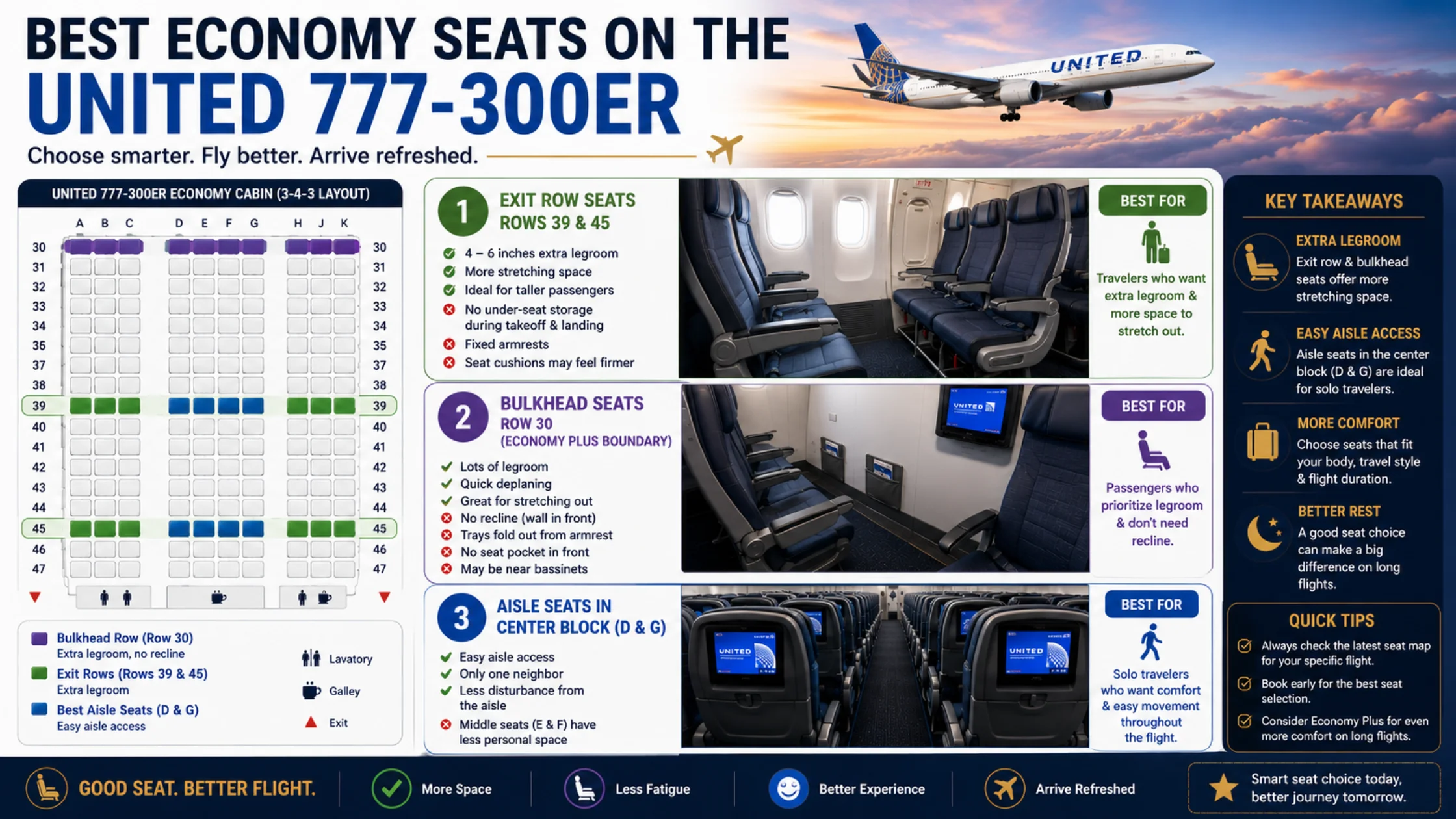
Exit Row Seats (Rows 39 & 45)
The United Boeing 777-300ER economy seats in the exit rows are the most recommended consistently. In addition, Row 39 and Row 45 (which may be different rows depending on tail number—always check on the United Airlines Boeing 777-300ER seat map) have a bit more legroom, typically 4 to 6 extra inches of pitch. However, there is no under-seat storage at takeoff and landing; on some models, seat cushions are a bit harder; and true exit rows have fixed armrests.
Bulkhead Seats (Row 30 — Economy Plus Boundary)
For the United Airlines Boeing 777-300ER Economy Plus configuration, the first row is the bulkhead, which is row 30. There will be a wall in front of these seats; thus, no one can recline in your seat. Selecting these seats will provide you with great legroom space. The drawbacks: trays fold out from the armrest (a bit cumbersome), there is no seat pocket in front of you for easy storage, and bassinet hooks can lead to a family with an infant being seated in the rows, which you should be aware of before a red-eye flight.
Aisle Seats in the Center Block (Seats D & G)
In the standard United Airlines 777-300ER economy, the best seat to choose when flying alone on a long transpacific flight is the aisle seat, either side-by-side or on the opposite side from the center 4-seat block (usually D and G). You will have unobstructed access to the aisles and you will have one armrest to yourself, and in reality you will probably never be stepped on more than once or twice on a long-haul flight, as the two middle passengers don't keep their heads out of the aisles.
Seats to Avoid on the United 777-300ER
Not all seats on the 777-300ER United Airlines are similar. As there are specific seats for greater comfort, there can be seats with limited flexibility and can impact your travel experience. It is best to avoid these seats.
Last Rows of Each Cabin Section
The rear-most economy level (usually in the 50s, depending on the configuration) suffers two disadvantages—either limited recline because the United Boeing 777-300ER economy seats are followed by the bulkhead or the galley or, at meal time, being the last section served. On a 13-hour transpacific flight, an extra waiting time of 30 to 40 minutes for the meal with an inability to recline makes it one of the worst choices.
Rows Adjacent to Lavatories and Galleys
Your seat is in the direct path of foot traffic if it's near a lavatory bank and near the galley during longer flights, and it's next to the galley, so it gets light and noise during overnight service runs in addition. Normally, this will occur in the forward economy section with the last three rows and the aft section with the first and last rows.
Window Seats Without Windows
A few window-marked seats on United Airlines 777-300ER economy, especially in the rear cabin, do not correspond to a window opening. Your window seat is occupied, but instead of a window you'll spot a blank wall. Before booking a seat, verify with close scrutiny of the United Airlines 777-300ER seat map whether the seat has a "misaligned window" or not.
Economy Plus vs. Standard Economy
The forward economy cabin—rows 20 to about 35—is home to United Airlines' Boeing 777-300ER economy plus. The actual and meaningful pitch advantage is a business class of 34 to 36 inches of pitch compared to the standard 31 inches. The extra 3-5" makes this an endurance for a comfortable flight on a 12-hour flight.
| Factors | United Economy Plus | United Economy |
| Number of seats | 62 | 204 |
| Seat numbers | 30A-33L, 34ABCJKL, 35ABCJKL, 45ABCJKL, 46DEFG | 34DEFG, 35DEFG, 36A-43L, 46ABCJKL, 47A-58G |
| Exit rows/doors | It is before and on row 30 and 45 | It is at the back of the cabin |
| Seat configuration | 3-4-3 | 3-4-3 |
| Standard seat pitch | 34" (86.3 cm) | 31" (78 cm) |
| Standard seat recline | 4" (10.1 cm) | 3" (7.6 cm) |
| Seat width | 17.05" (43.3 cm) | 17.05" (43.3 cm) |
| Movable aisle armrests | All aisle seats except bulkhead | All aisle seats |
| Fixed bassinets | 30E, 30F, 46E, 46F | No |
| Entertainment | Seatback entertainment and personal device entertainment | Seatback entertainment and personal device entertainment |
| Wi-Fi | Yes | Yes |
| Power outlets | Yes | Yes |
| USB ports | Yes | Yes |
Answering the question of whether or not economy is worth it on the United Airlines Boeing 777-300ER can be subjective based on the length of the flight. On flights below 8 hours, it is a bit of a comfort improvement. It is one of the top value upgrades to economy class, whereas on 11+ hour transpacific flights. The seat width stays the same (3-4-3), but a 34+ inch pitch on a Tokyo or Sydney flight is actually sleepable.
For those who are MileagePlus Premier, Economy Plus access is available at no cost for available seats at check-in at Gold level and higher. For frequent flyers of United, status is the cheapest access to this cabin.
Entertainment, Power & Connectivity on United 777-300ER
One of the best features of the Boeing 777-300ER United Airlines is its entertainment system. All of the economy seats have a personal touchscreen display that's 13 inches and can be accessed from the touchscreen to play your favorite movies, television shows, and music. The touch response is responsive, the screen resolution is sharp, and the content library is regularly updated, even if there is a good stock of international content suitable for the trans-Pacific routes that the aircraft usually flies.