The world has transformed digitally, everything from thick to thin can be found on the phones. Now things are shaped virtually, everything has to be portable and instant. In the same way, countries have given the biggest advantage to the travelers by launching e-visas in 2026. An electronic visa (e-visa) is an official permission by the government of any country for the citizens of other countries to gain access to enter the country.
E-visas will and have replaced the paper vignette/sticker that is there in the passport. This has helped the passengers a lot since carrying a passport and taking care of it is a bit of a hassle. In this guide, we will learn more about e-visas and what countries are eligible, what documents are required, and helpful tips to clear the interview process.
What does e-visa mean?
An e-visa is a digitally approved visa by the government of another country allowing the foreigner to enter the country legally. The whole process is completely online, which means that the person travelling would not have to go to the embassy, submit the documents, and give an in-person interview.
However, apart from e-visas, we do have other varieties of visas as well, and every visa is different from each other. Let's look at the breakdown of different visas below and understand the use of each.
Visa on arrival: You receive the visa when arriving at the airport, not before that. However, the disadvantage of receiving this airport is that the passenger would have to stand and wait in lines after a long flight. Plus, there might be chances of getting declined at the immigration.
Traditional Visa: This visa requires the person to complete the process in person, which includes the submission of the documents and interview as well. This is for the people who wish to stay in the country for a long period of time or need a work permit from that country.
ETA (Electronic Travel Authorization): This is specifically for those travelers who require a pre-travel clearance before travelling to the country. This is similar to the e-visa but falls in a different category in some of the countries, like the UK (ETA) and USA (ESTA). Basically, this is a pre-screening visa system for the visa-expedited travelers.
What are the benefits of an e-visa?
Since the visa has been digitized, a lot of travelers have benefited from it. Let's look at the advantages in detail to understand why it has been selected by most of the countries.
The biggest advantage is the traveler can apply for more than 1 person by sitting at home using just a laptop or mobile phone. It is available 24/7, hence there is no time limitation.
There is no need to commute to the embassy or a consulate physically, collect all the documents, and wait in long lines to get sorted with the procedure.
There are higher risks of losing your physical passport, which will have your visa in it. However, your e-visa will be stored with you on your phone.
You won't have to store it in a folder or bag, there are fewer chances for it to be lost, damaged, or stolen.
The traveler would not have to wait for longer hours, and the processing time shortens to a few days or a few hours.
It is cheaper than the other physical visas since you do not have to pay for the courier services or any travel fees to the embassy or visa office.
The traveler can easily track the visa process online without waiting for it to arrive by post.
Which countries offer e-visa facilities?
Shifting from a traditional visa to an e-visa is one of the biggest changes in travel history over the past decade. It was started by countries like India, Turkey, Kenya, Sri Lanka, Cambodia, Vietnam, and Azerbaijan, followed by many more countries.
This plan was initiated by the government to modernize immigration and gain more profit by tourism. More countries are getting into the race and making e-visas the new normal for short-term travels.
Countries like Saudi Arabia and the United Kingdom permit e-visas for business travelers. These countries are known to be the economic hub for the business travelers and they are also given a short-term business visa. Earlier, they used to go through a lot of paperwork, but now, it has been replaced by the e-visa.
Countries like Indonesia and others provide e-visas on arrival. The passengers would need to travel to that country and fill out the form on their arrival at the airport. This saves you from standing in long queues, you will be asked to make the payment online on the official Indonesia website and receive the visa on arrival.
However, there are still some countries that do not accept e-visas. North Korea, Turkmenistan, and some other countries are examples of not accepting e-visas.
What are the requirements of each country for an e-visa?
The requirements for an e-visa depend on the country-to-country. It specifically focuses on which county you belong to, what is the reason behind you visiting the other country, and how many days you will be staying in the country. All the passengers are requested to check the official visa website of that specific country before applying for it. The things that have to be checked are how long the application process will take, what the period of its validity and what the necessary documents are. Let's look at different countries, their validity, and their requirements.
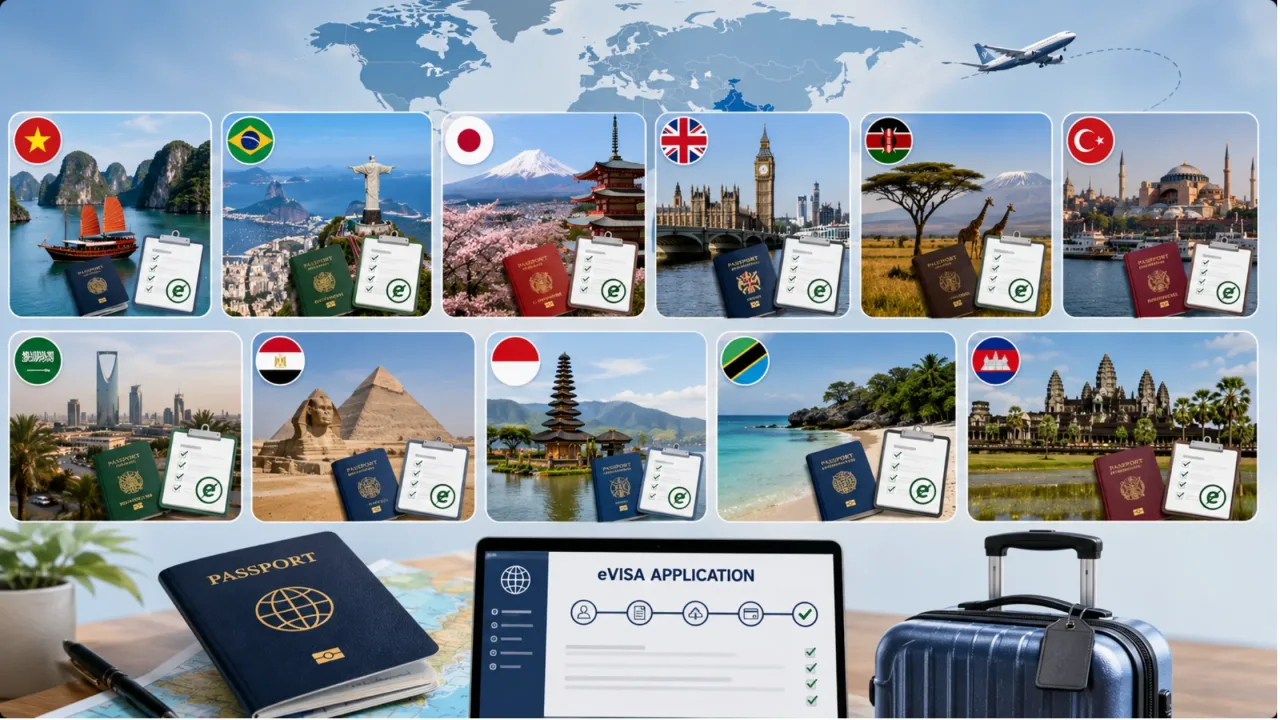
Vietnam
Vietnam’s e-visa is the most trending visa in the whole of South Asia. Citizens from any country are welcomed here.
Validity: The visa is valid for 90 days
Cost: $25 for single entry, $50 for multiple entry.
Requirements: A valid passport that is valid for 6 months and beyond the date of travel, a passport-size photo (no glasses), and a scanned bio-data page.
Processing: Submit all the documents online on the official vsa website of Vietnam. You will receive the visa within 3-5 business days.
Brazil
Citizens of the United States, Canada, Australia, and Japan are required to get an e-visa when travelling to Brazil. This requirement has become permanent from January 2026.
Validity: The visa is valid for 90 days.
Cost: $80-$81 for all the citizens. The visa is valid for up to 10 years for all US citizens.
Requirements: A passport with 6 months of validity and one blank page for the stamp, a recent passport-size photo, and a scanned biodata page.
Payment: Make the payment online through a credit/debit card on the official Visa page.
Japan
A Japan visa is for a short-term tourist visa, which is available for 90 days. The resilience is only limited to some of the countries (UK, US, Canada, and parts of the EU).
Validity: Single entry allowed. Can only stay for 90 days.
Cost: $95.27 for all the citizens, and make the payment at the official visa page.
Requirements: A valid passport, a recent passport-size photo, and the application must be submitted within 3 months of the travel date, and you should travel within 3 months of visa issuance.
Processing: It takes at least 7 business days.
United Kingdom
The UK visa is divided into two categories: a visa for the ones who want to visit the country, and the other is for visa-exempt citizens, which is also known as Electronic Travel Authorization (for example, US, Canadian, Australian, and EU citizens) who are visiting for a short period of time.
Validity: ETA is valid for 2 years. The traveler can visit the country anytime, without needing to reapply it. However, if you have got a new passport, then it is mandatory for the person to apply.
Cost: $16 for the ETA, and the standard visa fee for 6 months is $127. You can go to the official website and check the other fees as well.
Requirements: A valid passport, a passport-size photo, and an answer to all the security questions and contact details, and then make the payment online.
Processing: It depends on the workflow, sometimes it is accepted within minutes, and you will receive the email instantly, but sometimes it might take up to 3 days.
Saudi Arabia
The visa for Saudi Arabia is offered to many countries, like the US, UK, Canada, Australia, and the EU. The travelers can apply for it online on the official visa application website.
Validity: It is valid for 1 year. The traveler is allowed multiple entries and can stay for up to 90 days per visit.
Cost: $128, which includes a mandatory health insurance.
Requirements: A valid passport, passport-size photo, and proof of sufficient funds in the bank account.
Processing: It can take a few minutes or maybe 24 hours to receive the visa.
How to apply for an e-visa?
The most important point to keep in mind while applying for an e-visa is to keep all your documents ready with you and be very vigilant, read the visa application carefully before and after applying.
Below is a step-by-step guide to the visa application process.
Step 1: Check eligibility and visa type
Go through the official visa website of the specific country that you want to travel to. Check whether you are eligible to apply for that visa.
Step 2: Collect the documents
Make sure to keep all the required documents ready with you while filling up the application. You need to have a passport (valid for another 6 months and a blank page), a passport-sized photo, and in some cases, you will be asked to provide any proof related to your financial condition or the accommodation.
Step 3: Fill the form
Enter all the necessary details and passport information, and also mention the dates of travel, the same as they have been mentioned on the passport. Make sure that you are not making a grammatical mistake, as it can cause problems for you.
Step 4: Upload the required documents
Make sure to upload a clear picture of you and the passport in the correct format and size. It should not be blurred, otherwise, it will be rejected.
Step 5: Mention your itinerary
Mention all the dates and details of travel and where you will be staying. Double check that all the information is correct.
Step 6: Make the payment
Make the online payment through a credit/debit card.
Step 7: Make the submission and receive the application number:
When submitting the application form, you will be receiving a confirmation email with a reference number. You can use the reference number to track the visa application.
Step 8: Receive the e-visa
The processing time usually takes a few minutes to 72 hours, depending on the country and procedure. After the acceptance, you will receive the e-visa online in your email.
What is the processing time for an e-visa?

Standard Processing Time by Country
For highly automated systems like Turkey, approval can take minutes. For most other nations, the standard processing window is 3 to 7 business days. Public holidays in the destination country will halt processing, so plan accordingly.
Urgent/Express eVisa Processing
As mentioned, paying for premium processing can cut the wait time down to 1-2 days. However, if your application requires manual review due to a complex travel history, even express processing can face delays.
Factors That Can Delay eVisa Approval
Poor Document Quality: The leading cause is that people often take blurry passport photos.
Data Mismatches: When the name on your passport isn't exactly as on your application (pronoun + last name, last name, first name, etc.)
Security Flags: If the name is a common name and is listed on a security flag list, it requires human verification.
Conclusion
The e-visas have transformed international travel by replacing the traditional paper passport vignettes with secure, biometric digital visas. All work is done online before travel for quicker processing, increased security, and no lost documents. In this guide, it addresses that eVisas differ from visas on arrival and Electronic Travel Authorizations (ETAs), they are granted to all short-term tourists and business travelers from around the world but are still nationally restricted. Requirements for applying include high-resolution scans of the passport, digital photographs, and proof of onward travel, and approvals are usually processed within 3-7 days. The travelers will have to use the official government portal to avoid costly rejection or overcharging from third parties, ensure that they have the correct data in their passport, and apply for the travel three to four weeks prior to the departure.
Frequently Asked Questions
An e-visa is a digitally approved visa by the government of another country allowing the foreigner to enter the country legally. The whole process is completely online, which means that the person travelling would not have to go to the embassy, submit the documents, and give an in-person interview.
Whether you need an eVisa (electronic visa) or not depends completely on which passport you hold and where you are travelling to. Some countries allow visa-free travel, but some countries require an eVisa. An eVisa is an online application for permission to enter the country before you travel, meaning you don’t need a paper visa.
Official ESTA Application Website $40.27 USD if you qualify for the United States online travel authorization The standard physical tourist visa will cost you $185 USD as a base price, but a new $250 USD Visa Integrity Fee was just added, bringing the total standard visa cost up to $435 USD.
No, not all have eVisa (electronic visa). It is contingent upon your citizenship, your destination, and if you are a resident. Citizens of many countries, like the U.S. or EU, don’t need visas to visit dozens of places.