

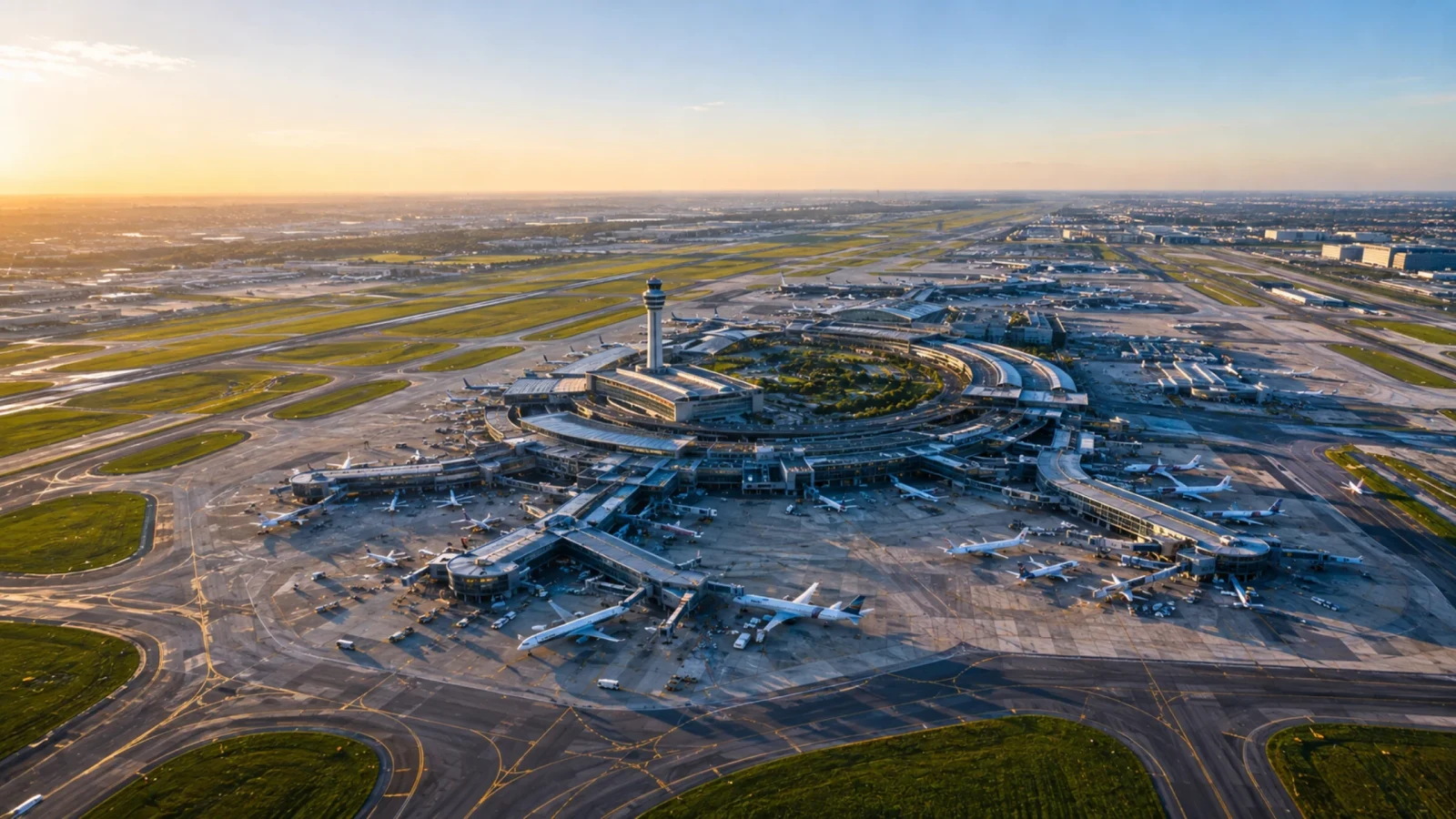
When people ask what is the largest airport in the world, most think it would be one with the highest traffic. However, that’s not true! Saudi Arabia's King Fahd International Airport is the largest in the world. The rank in this list is decided by the land area and not by the annual traffic, and the difference between the first and other nine airports is huge and massive. This guide lists the top 10 largest airports in the world by land area.
Top 10 Largest Airports in the World – Comparison Table
| Rank | Airport (Code) | Country | Land Area |
|---|---|---|---|
| 1 | King Fahd International Airport (DMM) | Saudi Arabia | 776 km² (299 sq mi) |
| 2 | Denver International Airport (DEN) | United States | 135.7 km² (52.4 sq mi) |
| 3 | Kuala Lumpur International Airport (KUL) | Malaysia | 100 km² (38.6 sq mi) |
| 4 | Istanbul Airport (IST) | Turkey | 76 km² (29.3 sq mi) |
| 5 | Dallas/Fort Worth International Airport (DFW) | United States | 69.6 km² (26.9 sq mi) |
| 6 | Orlando International Airport (MCO) | United States | 53.8 km² (20.8 sq mi) |
| 7 | Washington Dulles International Airport (IAD) | United States | 48.6 km² (18.8 sq mi) |
| 8 | Beijing Daxing International Airport (PKX) | China | 46.6 km² (18 sq mi) |
| 9 | George Bush Intercontinental Airport (IAH) | United States | 43.1 km² (16.6 sq mi) |
| 10 | Shanghai Pudong International Airport (PVG) | China | 40 km² (15.4 sq mi) |
1. King Fahd International Airport (DMM), Saudi Arabia
Inaugurated in 1,999, the King Fahd International Airport is the largest airport in the world by land area. This massive beast is six times the size of the runner-up, Denver Airport. The airport was named after the former king of Saudi Arabia, Fahd ibn Abdulaziz, and located 31 km northwest of downtown Dammam. The airport serves 43 destinations around the world. However, the airport was primarily a base for the United States, which was later transitioned to commercial use. As per the report, approximately 10 million passengers use this airport, and 37 airlines operate flights from this airport.
There are two runways 4 km longer each to support the landing and takeoff of flights. Further, the airport consists of three terminals in total. The passenger terminal is used mainly by the passengers for both international and domestic flights. Then, the Aramco Terminal is reserved for the employees of Aramco. And finally, the third terminal, named Royal Terminal, which is used by the Saudi royal family.
2. Denver International Airport (DEN), USA
Denver International Airport is the largest airport in the United States, spread across roughly 135.7 square kilometers of Colorado plains. The airport is highly acclaimed for its tent-shaped roof reflecting the Rockies. The airport commenced its operations in 1995 and serves 26 commercial airlines, including major US carriers such as United Airlines, Southwest Airlines, and Frontier Airlines. As per the report, the airport manages nearly 1,500 flights daily to over 200 destinations around the world.
The Jeppesen Terminal is the only terminal at the airport serving both the domestic and international flights. The airport is further divided into three concourses (A, B and C) with Concourse B being dedicated to the hub airline, United Airlines.
3. Kuala Lumpur International Airport (KUL), Malaysia
The Kuala Lumpur International Airport is the main international airport of Malaysia, situated in the Sepang district, approximately 45 km away from the city center. The airport handles 60 million passengers annually and is one of the airport largest in the world with a land area of 100 km. The KUL is a major operating base for airlines like Air Asia, Malaysia Airlines, and several other major international carriers.
There are three runways to facilitate both the domestic and international flights around the world. The airport is planning to bring new projects to accommodate the Airbus A380. It is the only airport in Malaysia that supports the landing and takeoff of the A380.
4. Istanbul Airport (IST), Turkey
Located in the Arnavutkoy district on the European side of Istanbul. The airport became fully operational in 2019, transferring all the commercial flights from Ataturk Airport and becoming the second busiest airport in the Middle East and Europe. The airport sits on 76 km with 5 runways (out of which three are operational and two are backups) to facilitate flights from across the world. It is the operating base for Turkish Airlines.
The airport was planned to be built in four different phases, and upon completion of all four phases, the airport will have the capacity of serving 200 million passengers annually.
5. Dallas/Fort Worth International Airport (DFW), USA
Dallas/Fort Worth International Airport is one of the largest airports in the world. By size, it ranks third in the world, spanning across 69.6 square kilometers, which is making it larger than the island of Manhattan. It is located at a distance of 26 km northwest of Downtown Dallas and 32 km northeast of Downtown Fort Worth. The airport is primarily serving the North Texas region and the Dallas-Fort Worth metroplex. This airport is the largest hub for American Airlines, with 900 flights operating daily.
The airport has five terminals (A, B, C, D, and E), where terminals A, B, and C are used specially for domestic flights. And the terminal is reserved for international flights, whereas the terminal welcomes both domestic and international flights.
6. Washington Dulles International Airport (IAD), USA
The capital of the United States of America deserves to have one of the largest airport in the world, Dulles International Airport. It stands at the sixth position by occupying a land area of 13,000 acres. On average, 60,000 passengers cross through the Dulles airport daily from more than 100 destinations across the globe. The busiest domestic routes include Denver, San Francisco, and Atlanta, whereas the airport receives the maximum number of international flights from London-Heathrow and Frankfurt.
Dulles is mainly known for mobile lounges that ferry passengers to remote gates and handles significant international traffic for the U.S. capital region.
7. Beijing Daxing International Airport (PKX), China
Situated on the border of Beijing and Langfang, Beijing Daxing International Airport is one of two international airports serving the capital of China. The airport covers an area of 6,620 acres of land. The airport is located 46 km south of Beijing, 26 km west of Langfang, serving majorly the Beijing, Tianjin and Hebei region. There are four runways facilitating the international and domestic flights from about 180 destinations. The airport commenced operations in 2019 and has since expanded its network to 25 countries worldwide, serving over 190 active routes.
The airport is also nicknamed “Starfish,” credit starfish-shaped single terminal supporting both domestic and international flights via connected concourses. Daxing serves as major for
Air China, Beijing Capital Airlines, and China Eastern Airlines. The airport was constructed with a view to divert the traffic of Beijing Capital International Airport. And with continuous expansion, the airport is expected to handle 200 million passengers annually.
8. Orlando International Airport (MCO), USA
Among the largest airport in the world, the Orlando International Airport stands at the eighth position. The airport spans roughly 53.8 square kilometers. It is built just 9.7 km southeast of downtown, which makes it a prime choice for tourists heading towards the region's theme parks. The airport serves as an operating base for Breeze Airways, Frontier Airlines, and Southwest Airlines. It has reported approximately 850 flights a day with 44 airlines from 135 destinations across the globe.
The airport was originally constructed for military use in 1942, but transitioned for civilian use in 1961. Since then, the airport has seen a spike in the number of passengers every year due to its proximity to Walt Disney World and other major attractions.
9. George Bush Intercontinental Airport (IAH), USA
Originally named Houston Intercontinental Airport and renamed in 1997 in honor of George H. W. Bush, the 41st U.S. president. It is the primary international airport serving the metropolitan area of Greater Houston. The airport spans 10,000 acres making it one of the largest airport in the world by land area, and second busiest airport in Texas by volume of passengers. It served as a hub for United flights.
George Bush Intercontinental Airport has five major terminals, where Terminal A and Terminal D are used for non-United domestic and non-United international flights, respectively. The remaining Terminal (B, C, and E) is primarily used for United Airlines flights.
10. Shanghai Pudong International Airport (PVG), China
Shanghai Pudong International Airport covers about 40 square kilometers and ranks among China's busiest cargo and passenger hubs. The airport primarily serves international flights and a smaller number of domestic flights. China Eastern Airlines and Shanghai Airlines are the major airlines at PVG, and the airport is also a major international hub for Air China.
The airport started its operation in 1,999 with only one runway, and has expanded to four operational runways as of now, and two are under construction. Also, the passenger handling capacity is set to rise from 60 to 80 million with the completion of the third terminal, along with the ability to handle 6 tons of freight.
Conclusion
King Fahd International Airport has the record of being the largest airport in terms of land area, totaling 776 square kilometers, much bigger than other airports around the world. The United States has five of the top 10 largest airports in the world, which are Denver, Dallas/Fort Worth, Orlando, Washington Dulles and Houston Intercontinental. Other ways around, there are also mega-hubs in Asia and Africa, such as Beijing Daxing and Shanghai Pudong. Their overwhelming scale illustrates the scale of strategic infrastructure, huge land investments, and long-term expansion potential that has transformed major cities into aviation centres to meet growing commercial, cargo and regional transportation requirements.
Frequently Asked Questions
The top 10 largest airport in the world includes, King Fahd International Airport (DMM), Denver International Airport (DEN), Kuala Lumpur International Airport (KUL), Istanbul Airport (IST), Dallas/Fort Worth International Airport (DFW), Orlando International Airport (MCO), Washington Dulles International Airport (IAD), Beijing Daxing International Airport (PKX), George Bush Intercontinental Airport (IAH), and Shanghai Pudong International Airport (PVG).
Denver International Airport, Dallas/Fort Worth International Airport, and Washington Dulles International Airport are the top three largest airports by land area in the United States of America.
King Fahd International Airport (DMM) in Dammam, Saudi Arabia, spans 300 square miles (776 square kilometers) and is the largest airport in the world by land area.
King Fahd International Airport (DMM) is the largest airport in the world, nearly six times of the second largest airport, Denver Airport.
Chicago O'Hare International Airport (ORD) has the highest number of gates in the United States, currently operating between 191 and 216 gates across four active terminals.
More From Airport
AIRPORT
JFK Arrivals Today and Everything You Need for a Hassle-Free Arrival
AIRPORT
Navigate the Charlotte Airport and Find Your Way Around with Ease
PARKING
The Insider Guide to San Diego Airport Parking Rates, Rules, and Secret Hacks
PARKING